The
Necessary Personal Oral Hygiene
For Prevention of Caries and Periodontoclasia*
|
|
by Charles C. Bass,
M.D |
- Page 5-continued
-
What seems to be the same kind of partial
decalcification may be produced experimentally by solutions
of organic acids, such, for instance, as lactic acid—the one
generally supposed to be the most important in caries
production. However, weak solutions of
-
-
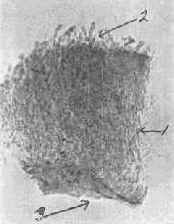
Fig. 8. Piece of the bacterial
film from over early stage caries lesion.
Specimen teased off, stained very lightly with
safranin and mounted in 50 per cent glycerin for
photographing by transmitted light. Note
filamentous nature of bacterial material (1) and
growing ends and fruiting heads at outer surface
(2). Inner surface (3).
|
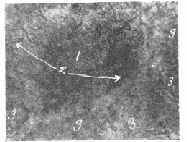
Fig. 9. Bacterial film pile
on surface of tooth over early stage caries ( chalky
enamel ) stained lightly with safranin and
photographed with incident light. Note mound of L.
racemosa (1) with some fruiting heads focused around
periphery (2). Many more just out of focus. |
- organic acids, such as can be assumed to be formed at
caries disposed locations, act very slowly. It is only after
long continued exposure to such weak acids experimentally
that demonstrable partial decalcification occurs. Likewise
it is only after long continued and repeated production of
acids by bacterial action, that a caries lesion results. It
is very apparent that to prevent early stage caries at any
vulnerable place on a tooth, it is necessary to prevent the
formation of acids by bacteria growing there*
-
- Time Factor In
Production of Acids By Bacteria
- Some bacteria grow and produce acids much more rapidly
than others. However any of them require considerable
growing time, under the most favorable conditions, for
production of appreciable amounts (or strengths). Perhaps
the most familiar example for those who have been medical or
dental students is the testing of acid production by pure
cultures of different bacteria inoculated into litmus milk.
Litmus milk is blue. A tube of such culture media inoculated
with a loopful of a pure culture of an acid producing
organism and placed in the incubator still remains blue for
several hours, usually twelve or fifteen or more. After the
necessary incubation time it will be noted that the color is
changing to a faint pink and finally, within twenty-four
hours or a longer period, to red, indicating production of
considerable lactic acid from the sugar in the milk.Stephan
and Millers showed that brushing the teeth thoroughly before
rinsing with 10 per cent glucose solution eliminated the
fall in pH which otherwise would have occurred. They found
that in testing plaque material in situ
for pH drop following the glucose rinse, subjects who
refrained from brushing their teeth for three or four days,
thereby insuring a sufficient amount of bacterial material
on accessible surfaces, gave most satisfactory results.
Therefore a considerable period of time is required for
sufficient growth and accumulation of bacteria to occur
before much acids can be produced in the presence of
carbohydrates.
- *Note: I am
aware of the suggestion, belief or claim by recent authors
(6, 7, 8, 9, 10, 11, 12, 13, 14) that caries is, to some
extent, a proteolytic process by which the organic material
of the enamel is invaded and broken down by the enzymes of
proteolytic bacteria and that this is followed or
accompanied by disintegration or decalcification of the
inorganic material. The personal oral hygiene for prevention
herein specified would be equally applicable to such order
of events in the caries process.
-
Continued...
|