The author has instructed and had under
observation, a sufficient number of subjects to be able to state
positively the beneficial effects that result from the personal
oral hygiene herein specified.
1. No new caries lesions develop.
2. Early stage lesions (mostly unrecognized
"white spot" partially decalcified enamel that has not broken
down) do not progress further or break down.
3. Small shallow cavities do not progress but
usually become inactive.
4. Correctly made fillings do not undermine
or break down.
5. No new periodontoclasia lesions occur.
6. All early stage periodontoclasia lesions
heal promptly. It is almost dramatic the way in which the
bleeding from the gingival crevices stops entirely after the
first few days. Pus (even microscopic quantities) is no longer
present in material from most of the crevices, and greatly
diminished in that from others. The delayed or incomplete
healing in such lesions is usually due either to calculus or
scale on the tooth within the crevice or to irregularities or
other conditions on the surface of the tooth which prevent
accurate application of the floss. In most such instances,
removal of the foreign material from the surface of the tooth
at, and within, the gingival crevice by the dentist, followed by
the right personal oral hygiene, results in prompt subsidence of
the disease.
7. Each advanced stage periodontoclasia
lesion and deep "pyorrhaea pocket" is a separate problem.
However, cleaning off the tooth at and within the lesion by the
dentist at suitable intervals together with faithful application
of the personal oral hygiene described herein usually will yield
most gratifying results. The beneficial results will depend
largely upon the extent of the lesion and the damage already
done. In favorable instances
suppuration and inflammation of periodontal tissues subside, and
loose, drifting teeth usually stabilize.


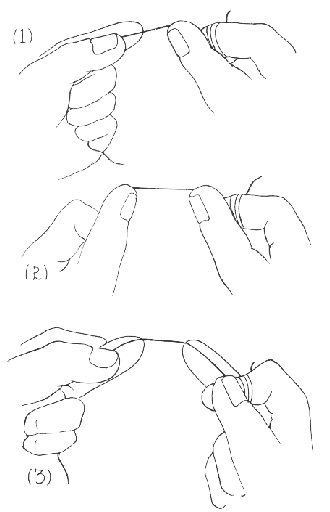 Fig. 18. Best way to hold
floss in cleaning the teeth. For upper right (1). For upper
left (2). For lowers (3).
Fig. 18. Best way to hold
floss in cleaning the teeth. For upper right (1). For upper
left (2). For lowers (3).