The
Necessary Personal Oral Hygiene
For Prevention of Caries and Periodontoclasia*
|
|
by Charles C. Bass,
M.D |
Page12-continued
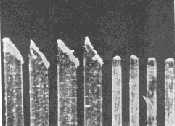
Fig. 14. Selected .014" bristles
(left) from current toothbrush by the side of .007" bristles
with smoothed and rounded ends from right kind brush. |
The specifications for
the right kind of toothbrush are:
1. Plain straight-handle design; over-all
length about 6", width about 7/16"; 3 rows of bristles, 6
tufts to the row, evenly spaced (Figure 16) .
2. High quality nylon bristles, about 80
per tuft, .007" diameter, straight trim, finished to 13/32"
length.
3. Ends of bristles ground and finished
to hemispherial shape or at least so as to eliminate all
sharp points and rough edges.
4. A similar brush of reduced size for
the use of young children should have an overall length of
about 5", .005" bristles, finished to 11/32" length. |
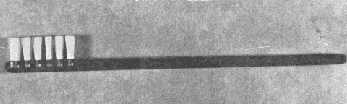
Fig. 15. Right kind
toothbrush referred to
in this paper and described elsewhere (3). Note straight
handle and construction and straight trim. |
Based
upon much study of the spaces to be cleaned, the character of
the material to be removed, and the conditions to be met, the
author has specified elsewhere (3) the optimum characteristic of
toothbrushes for personal oral hygiene, giving the reason for
each of the characteristics specified. The specifications laid
down meet the requirements indicated above. This, and no other,
is the right kind of toothbrush. In the light of present
information any brush that deviates from the characteristics
specified is less effective and less appropriate for the
purpose, to the extent it so deviates.
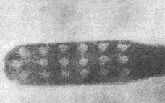
Fig. 16. Face view of right kind toothbrush, showing
distribution of tufts.
Brushing The Teeth
All the
surfaces of all the teeth to which the brush can be applied,
should be brushed. A good system is to brush the buccal and
labial surfaces of all teeth first, then the occlusal and
lingual surfaces of the grinders in all four quadrants and
finally the lingual surfaces of the anterior teeth. The bristles
of the heel of the brush can be applied most effectively to the
lingual surfaces and the gingival crevices of these latter
teeth. The bristles of the distal end or toe of this right kind
of brush can be applied most effectively back of the last tooth
in each quadrant by tilting the brush for this purpose at the
same time the occlusal and lingual surfaces of the grinders are
brushed. Anyone should be able to brush all of these teeth well
enough for all purposes in less than one minute.
Continued...
|