The
Necessary Personal Oral Hygiene
For Prevention of Caries and Periodontoclasia*
|
|
by Charles C. Bass,
M.D |
Page10-continued
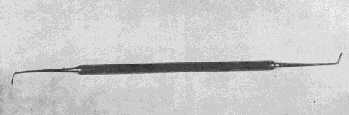
Fig. 13. Explorer and scraper
("Bass' 55") for exploring, scraping and securing material
from gingival crevices and periodentoclasia lesions. |
The material is spread in a small area (2 to
5 mm. in diameter is enough) upon a microscope slide. Removal of
the small amount of material from the blade of the explorer and
spreading it upon the slide can be facilitated by the use of
some kind of teasing needle or other small pointed instrument.
Several such specimens from different crevices can be placed at
different locations on one slide, and all stained and examined
at the same time. The author usually mounts on one slide for
examination all the specimens taken at a sitting from a given
subject.
The slide is ready for staining and
examination. Any one of many staining methods may be used
satisfactorily. A good one for general purposes is as follows:
(1) Fix with heat; (2) Carbol fuchsin one-half minute; (3)
Rinse; (4) Crystal violet one-half to one minute; (5) Wash, dry
and mount in oil for examination.
Pus and other cells are satisfactorily seen
with the low power (16 mm.) objective. Higher powers and the oil
immersion objective are needed for study of the bacteria,
spirochetes and ameba (Endameba
buccalis) that may be
present.
Widespread Prevalence of
Periodontoclasia
Periodontoclasia is practically a universal disease. There are
suppurating lesions about some or all of the teeth of all people
except those who have learned and follow the necessary personal
oral hygiene to prevent the disease. Anyone who is interested
can confirm this by examining, as indicated above, material from
his own interproximal gingival crevices, and from those of
others.
Inflamed and ulcerated inner surfaces of the
free gingiva bleed easily from the slightest force or
manipulation. Uninflamed epithelial surfaces do not bleed
Therefore "bleeding gums" can be considered practically
diagnostic of inflammation and ulceration—the early stage of
periodontoclasia.
In view of the widespread prevalence of this
disease it is hardly necessary, for diagnostic purposes, to make
microscopic examinations for pyorrhaea, as suggested above. It
can be assumed to be present about some of the teeth of
practically all adults and most younger people. During a period
of several years the author has examined a considerable number
of people, mostly medical students and other university
personnel. In no instance has he failed to find pus from some of
the gingival crevices, and also one or more demonstrable lesions
where some receding of the gingival attachment has taken place.
This experience, which will be confirmed by those who employ
appropriate technic, indicates the extensive prevalence of the
disease, the inadequacy of the oral hygiene procedures presently
in general use and the need for a better method.
Continued...
|